What exactly is FIT-Connect?
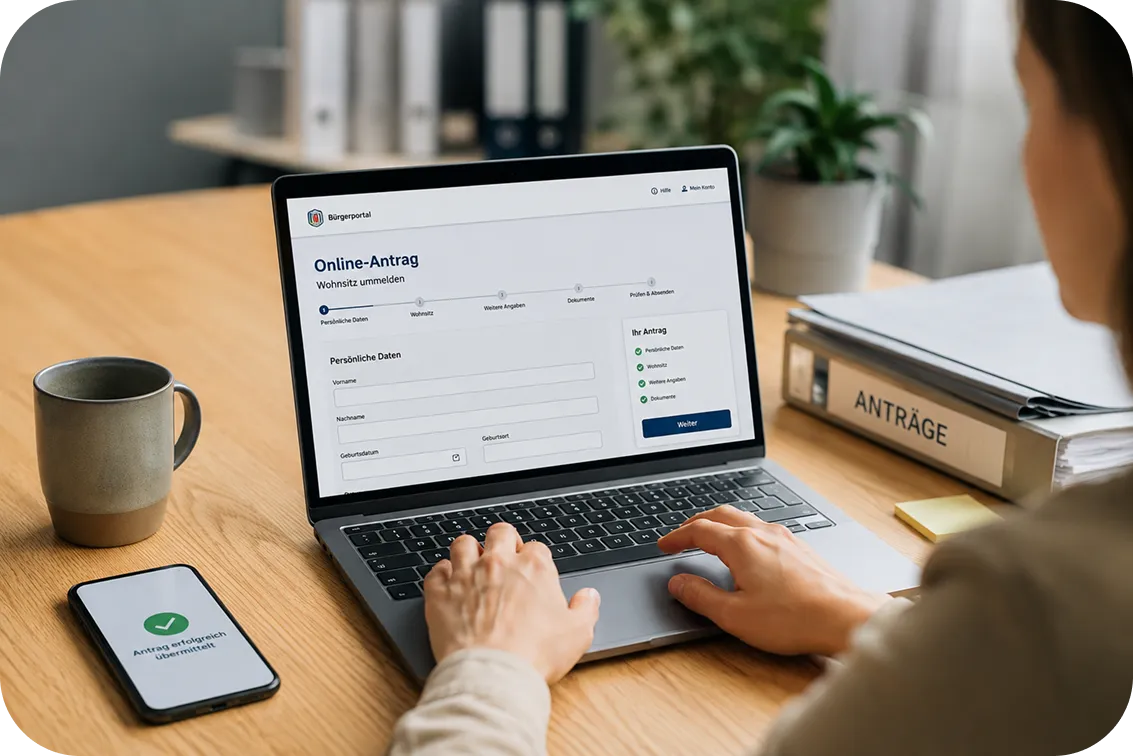
In short: FIT-Connect is the central delivery platform for applications between online services and government agencies. It is operated by FITKO, the Federal IT Cooperation, on behalf of the federal and state governments. The whole system functions as a kind of “federal hub for digital applications.” An online service – such as a portal for change-of-address notifications, building permits, or parental leave benefits – compiles the application data and forwards it to FIT-Connect. From there, the encrypted data package is sent on to the relevant government agency.
Why is this even necessary?
The Online Access Act (OZG) requires the federal government, states, and local governments to offer their administrative services digitally. At first glance, it sounds like, “Just do it.” In reality, however, it means: over 500 services, more than 11,000 local governments, dozens of specialized procedures, and every government agency with its own software landscape, developed over decades. Without FIT-Connect, every online service would have to build its own interface for every government agency. That scales about as well as a fax machine during a pandemic outbreak. FIT-Connect breaks this n-to-m nightmare down to a simple pattern: Online services communicate with FIT-Connect. Government agencies communicate with FIT-Connect. And FIT-Connect takes care of the rest.
What makes it technically unique?
Without going into too much detail, there are three things worth mentioning:
- End-to-end encryption: Not even FIT-Connect can read the application data. Encryption takes place within the online service, and decryption occurs only at the receiving agency. Data protection isn’t an afterthought here – it’s built right in.
- Automatic routing: Anyone submitting an application does not need to know whether the City Hall, the District Office, or a specialized agency is responsible. FIT-Connect finds the correct recipient based on service and location.
- Open standards and free of charge: REST APIs, OpenAPI specifications, OAuth2 – nothing exotic. Use is free of charge for public administration.
What does that actually mean?
For citizens
Applications that remain digital from start to finish. No media breaks, no “Please print this out again.”
For government agencies
A single interface that can connect to any number of online services. Once connected, you’re all set for the future – even if a new portal is added tomorrow.
For providers of online services
A clear integration goal. Instead of negotiating with each federal state individually, the system is being built to be compatible with FIT-Connect, making it theoretically connectable nationwide.
What happens next?
FIT-Connect isn’t a final destination, but rather a common ground where a lot is currently happening. Things are getting particularly exciting on three fronts:
- Greater reach: More and more municipalities and specialized procedures are being connected. The denser the network, the more valuable the platform – a classic network effect.
- Integration with EfA services: “One for All” solutions, in which one federal state implements a service for all others, require exactly this type of transport channel.
- Europe: With the Single Digital Gateway, the EU is unifying national administrative portals. FIT-Connect fits well into this framework structurally and has the potential to become a German building block in a European architecture.
In the long run, this is also the most pressing question: Once the issue of data transfer is resolved, the focus shifts to data processing. Pre-filled forms, automated validity checks, and AI-powered data processing only become relevant once the data arrives at its intended destination in a structured and secure manner. FIT-Connect is essential for this.
Our contribution
In a proof of concept, we connected a citizen portal to FIT-Connect to walk through the end-to-end process ourselves, from the citizen’s click on the portal to the encrypted receipt by the government agency. The takeaway: The platform is surprisingly easy to integrate once the concepts are understood. And that’s exactly where we want to start – not every municipality should have to reinvent the wheel. A modern online service that incorporates FIT-Connect from day one, rather than adding it as an afterthought, looks noticeably different from a retrofitted legacy system.
